Love-In
[[Release Detail]][[Release Description]]
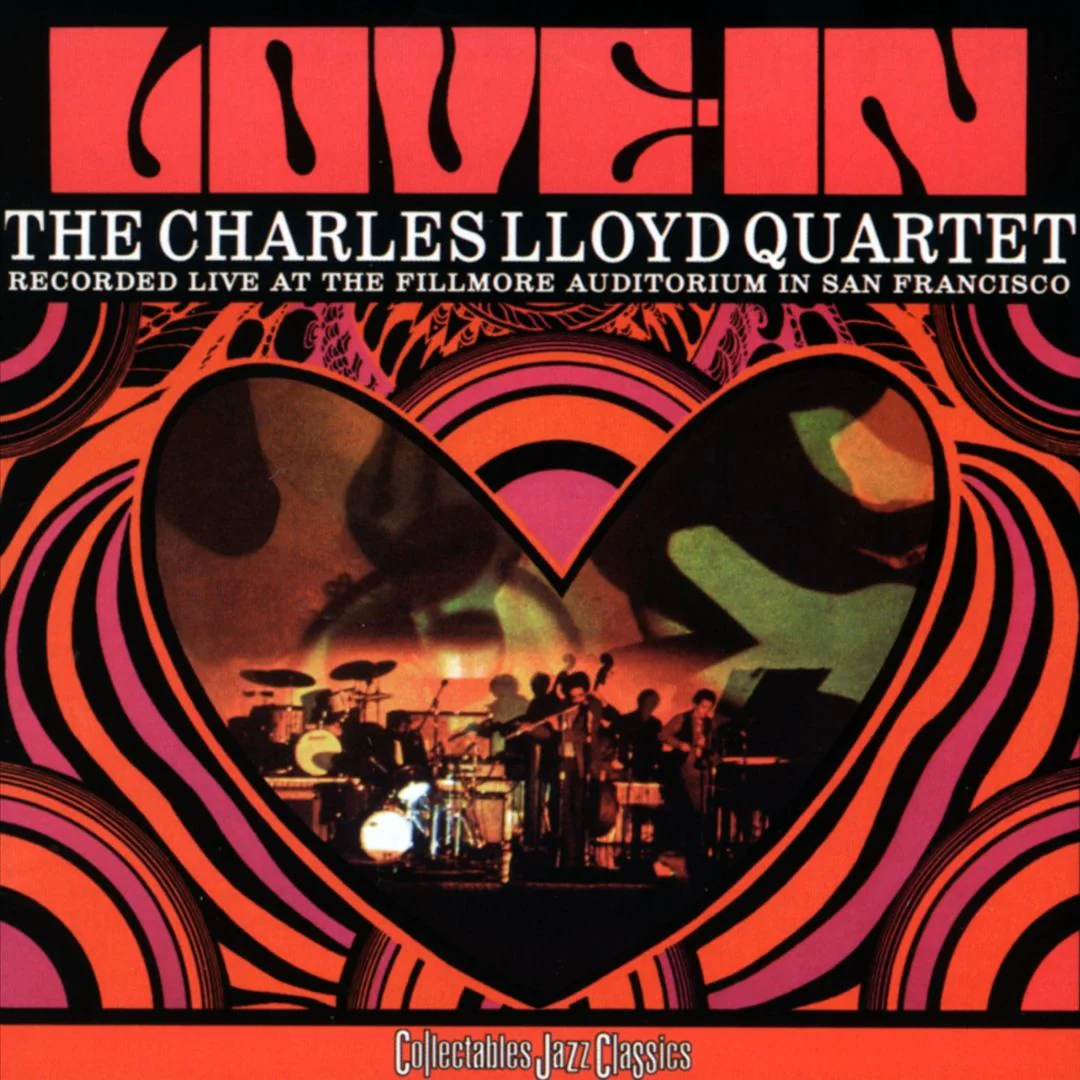
Four-and-a-half decades after the event, saxophonist Charles Lloyd’s Love-In, recorded live at San Francisco’s Fillmore Auditorium in 1967, the counterculture’s West Coast music hub, endures as much as an archaeological artifact as a musical document. From sleeve designer Stanislaw Zagorski’s treatment of Rolling Stone photographer Jim Marshall’s cover shot, through the album title and some of the track titles (“Tribal Dance,” “Temple Bells”), and the inclusion of John Lennon and Paul McCartney’s “Here There and Everywhere,” Love-In’s semiology reeks of the acid-drenched zeitgeist of the mid 1960s, a time when creative music flourished, and rock fans were prepared to embrace jazz, provided the musicians did not come on like their parents: juicers dressed in sharp suits exuding cynicism.
It is likely that more joints were rolled on Love-In’s cover than that of any other jazz LP of the era, with the possible exception of saxophonists John Coltrane’s A Love Supreme (Impulse!, 1965) and Pharoah Sanders’s Tauhid (Impulse!, 1967). Chet Helms, a key mover and shaker in the West Coast counterculture, spoke for many when he hailed the Lloyd quartet as “the first psychedelic jazz group.”
It is to Lloyd’s credit that, at least in the early stages of his adoption by the counterculture, he resisted dumbing down his music. The adoption stemmed from Lloyd’s espoused attitude to society, his media savvy, his sartorial style and his sheer nerve in playing jazz in the temples of rock culture. He took the quartet into the Fillmore West three years before trumpeter Miles Davis took his into the Fillmore East—as documented on Live at the Fillmore East, March 6 1970: It’s About That Time (Columbia)—by which time his pianist, Keith Jarrett, and drummer, Jack DeJohnette, were members of Davis’ band (although Jarrett didn’t appear at the 1970 gig).
So Love-In comes with a load of baggage, some of it less than fragrant. But as 45 minutes of music, it still has legs. Lloyd’s vocalized tenor (and flute on two tracks) has Coltrane-derived muscle; the young Jarrett’s lyrical and funky solos, particularly on his 07:55 showcase, the gospel-ish “Sunday Morning,” his two featured originals (“Sunday Morning” and the soul jazz-ish “Is It Really the Same?”), and his playing the strings of the piano directly with his hands, all remain compelling; McClure and DeJohnette are solid and inventive.
[[Selling Points]]
- LP pressed on black vinyl
- Recorded live at San Francisco’s Fillmore Auditorium in 1967
- Hailed as “the first psychedelic jazz group"
[[Catalog Number]]PPAN-SD11481[[Artist]]Charles Lloyd
Original: $27.00
-70%$27.00
$8.10Product Information
Product Information
Shipping & Returns
Shipping & Returns
Description
[[Release Detail]][[Release Description]]
Four-and-a-half decades after the event, saxophonist Charles Lloyd’s Love-In, recorded live at San Francisco’s Fillmore Auditorium in 1967, the counterculture’s West Coast music hub, endures as much as an archaeological artifact as a musical document. From sleeve designer Stanislaw Zagorski’s treatment of Rolling Stone photographer Jim Marshall’s cover shot, through the album title and some of the track titles (“Tribal Dance,” “Temple Bells”), and the inclusion of John Lennon and Paul McCartney’s “Here There and Everywhere,” Love-In’s semiology reeks of the acid-drenched zeitgeist of the mid 1960s, a time when creative music flourished, and rock fans were prepared to embrace jazz, provided the musicians did not come on like their parents: juicers dressed in sharp suits exuding cynicism.
It is likely that more joints were rolled on Love-In’s cover than that of any other jazz LP of the era, with the possible exception of saxophonists John Coltrane’s A Love Supreme (Impulse!, 1965) and Pharoah Sanders’s Tauhid (Impulse!, 1967). Chet Helms, a key mover and shaker in the West Coast counterculture, spoke for many when he hailed the Lloyd quartet as “the first psychedelic jazz group.”
It is to Lloyd’s credit that, at least in the early stages of his adoption by the counterculture, he resisted dumbing down his music. The adoption stemmed from Lloyd’s espoused attitude to society, his media savvy, his sartorial style and his sheer nerve in playing jazz in the temples of rock culture. He took the quartet into the Fillmore West three years before trumpeter Miles Davis took his into the Fillmore East—as documented on Live at the Fillmore East, March 6 1970: It’s About That Time (Columbia)—by which time his pianist, Keith Jarrett, and drummer, Jack DeJohnette, were members of Davis’ band (although Jarrett didn’t appear at the 1970 gig).
So Love-In comes with a load of baggage, some of it less than fragrant. But as 45 minutes of music, it still has legs. Lloyd’s vocalized tenor (and flute on two tracks) has Coltrane-derived muscle; the young Jarrett’s lyrical and funky solos, particularly on his 07:55 showcase, the gospel-ish “Sunday Morning,” his two featured originals (“Sunday Morning” and the soul jazz-ish “Is It Really the Same?”), and his playing the strings of the piano directly with his hands, all remain compelling; McClure and DeJohnette are solid and inventive.
[[Selling Points]]
- LP pressed on black vinyl
- Recorded live at San Francisco’s Fillmore Auditorium in 1967
- Hailed as “the first psychedelic jazz group"
[[Catalog Number]]PPAN-SD11481[[Artist]]Charles Lloyd